Written by Vivek Maswadkar
Founder and developer, Krishi AI
Source-backed field guide
AI can help organise farming questions, inspect crop-photo clues, combine field information, and make market or advisory data easier to use. It cannot turn incomplete inputs into certainty, replace local agronomy, or prove a better yield, price, or income without field evidence.
Reviewed
Founder and developer, Krishi AI
Product-claims and source review
Review covered the cited public sources, current Krishi AI product contract, privacy boundaries, and wording certainty. This is not an independent agronomy efficacy review.
Four practical jobs
Each use starts with a possible benefit, keeps the evidence limit adjacent, and ends with a farmer check.
Can help
A conversational tool can ask for crop, stage, location, weather, soil, recent inputs, and the decision a farmer is considering. It can then organise possible next questions or actions.
Cannot prove
A fluent answer is not proof that the facts are current, locally registered, or right for the field. Missing context can change the answer.
Farmer check
Look for the source, date, location scope, uncertainty, and what evidence would change the recommendation. Verify consequential advice locally.
Can help
Computer-vision systems can group visible patterns such as spotting, yellowing, curling, holes, or pest-like damage and suggest information to collect next.
Cannot prove
One photo may not separate disease, pest, nutrient, chemical, water, or weather stress. It cannot provide laboratory confirmation.
Farmer check
Capture more than one clear angle, include crop stage and field history, and confirm treatment decisions with a qualified local agronomist or extension worker.
Can help
Digital systems can help compare structured observations across time and place. India's Digital Agriculture Mission describes agriculture data infrastructure and a Krishi Decision Support System for crop, soil, weather, and water information.
Cannot prove
A national data platform does not guarantee that every field record is complete, current, consented for every use, or suitable for an individual decision.
Farmer check
Check who collected the data, its date and resolution, whether it represents the field, and what happens when the source is missing or wrong.
Can help
A tool can filter government-published wholesale minimum, modal, and maximum market records by commodity, market, and date.
Cannot prove
A published record is not a live offer, guaranteed selling price, complete market view, or promise of a better price.
Farmer check
Read the actual record date and confirm quality grade, quantity, fees, transport, and current transaction terms with the market.
The most useful AI workflow is one that makes uncertainty and verification easier to see.
Transparent product example
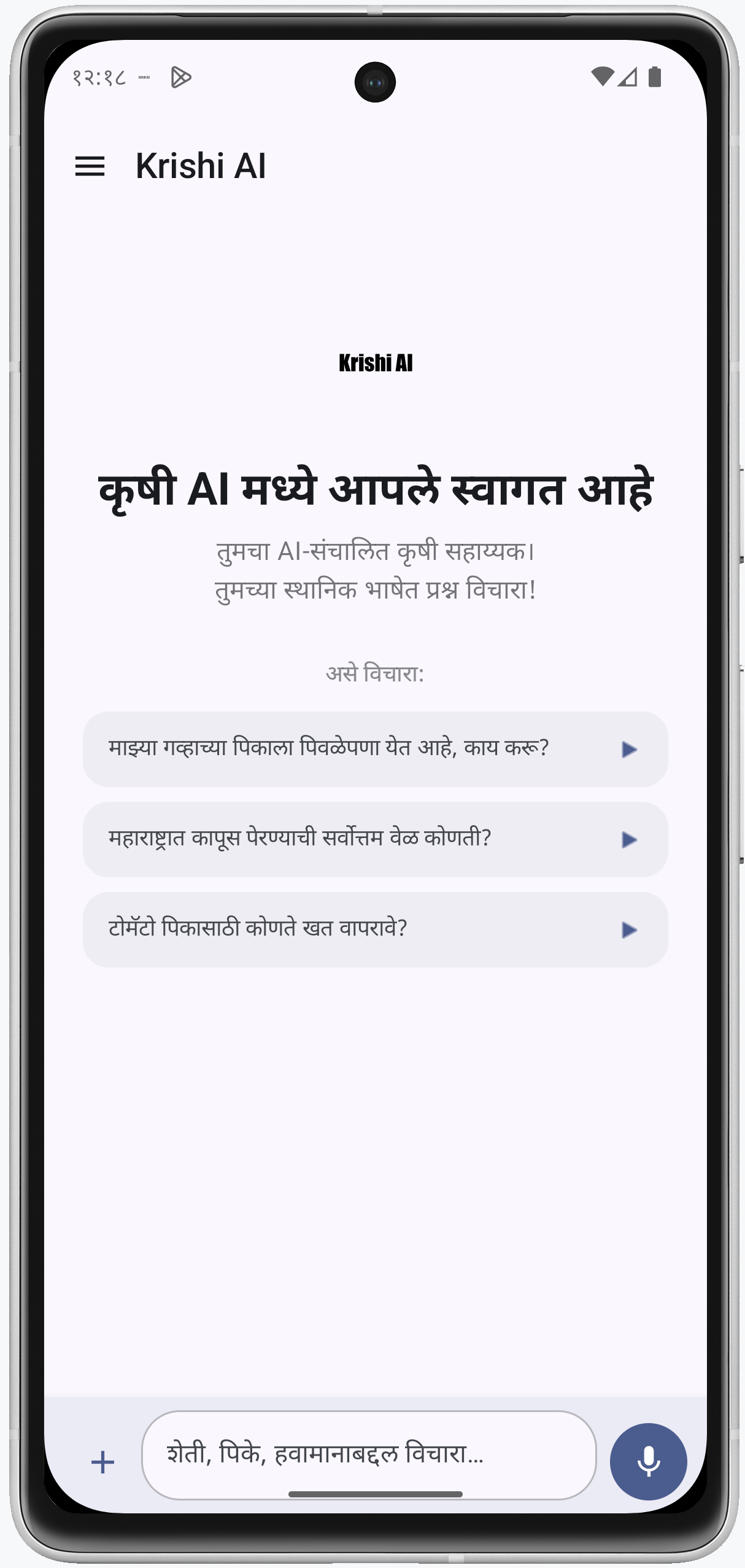
Krishi AI is an Android app built by Vivek Maswadkar. It offers AI-generated farming guidance, crop-photo insights for likely problems, and dated government-sourced mandi records for configured Maharashtra coverage.
This is an edited visual transcript, not a word-for-word quotation. It was checked against the public 8:43 walkthrough and its visible automatic captions on 16 July 2026. Where older narration is broader than the current product-claims contract, the notes below use the current bounded wording.
Watch Krishi AI - Walkthrough on YouTube (8:43)Uploaded 2026-05-28 by Generative AI for the Beginner's Mind.
The walkthrough opens in Krishi AI and introduces farming questions as the product context.
The presenter describes a Maharashtra farming background and the goal of making useful technology easier to reach from a phone.
The walkthrough groups the app around farming questions, crop-photo analysis, and market-price records. These are product capabilities, not outcome guarantees.
A question includes location, soil, water, and crop-choice context. The useful pattern is to provide decision-relevant context and then verify important advice.
The app demonstrates selecting a plant image and receiving likely problem information. A photo result remains a starting point, not a definitive diagnosis.
The walkthrough returns to the one-tap plant-analysis entry point and shows how a farmer reaches the image workflow.
The final section shows market records and a price-movement view. Users still need the actual data date and direct market confirmation before a transaction.
Reviewed sources
These public sources establish the guide’s policy, governance, extension, and market-data context. They do not endorse Krishi AI or prove its outcomes.
Press Information Bureau, Government of India
Cabinet approves the Digital Agriculture MissionIndia context: agriculture DPI, Krishi DSS, crop, soil, weather, water, AI, and remote-sensing scope.
Source reviewed 2026-07-16
Food and Agriculture Organization of the United Nations
Digital Agriculture and AI InnovationResponsible-use framing: inclusion, data governance, farmer rights, local context, validation, and measurable impact.
Source reviewed 2026-07-16
Indian Council of Agricultural Research
Krishi Vigyan Kendras (KVKs)Local verification and extension: district-level diagnostic, advisory, training, and knowledge roles.
Source reviewed 2026-07-16
Open Government Data Platform India
Current daily price of various commodities from various markets (Mandi)What the AGMARKNET-derived wholesale minimum, modal, and maximum price records represent.
Source reviewed 2026-07-16
Ask one focused farming question, read the visible source or date, and check critical decisions with a qualified local professional.
This page uses no private chat, crop image, testimonial, partner claim, or claimed farm outcome.